Back
Insights

Quick Answer
Measure AI search visibility by tracking whether B2B buyer prompts mention your brand, cite your pages, describe you accurately, and produce qualified visits or pipeline. Combine a repeatable prompt panel with first-party search, analytics, and CRM data, then report trends by engine instead of treating any single AI response as a ranking.
Introduction
AI search visibility is now a material part of B2B search performance because buyers increasingly ask ChatGPT, Perplexity, Claude, and Google AI features to narrow their options before visiting a website. Traditional ranking reports cannot show whether an assistant named your company, cited its content, or gave an inaccurate description of its offering. The practical solution is a measurement system that separates observed AI-answer presence from referral traffic and downstream commercial outcomes. That distinction prevents executives from mistaking a quiet referral report for an absence of buyer influence.
Key Takeaways:
Track mentions, citations, answer accuracy, referrals, and qualified pipeline separately.
Use a fixed buyer-prompt panel to identify trends across AI engines.
Connect visibility observations to CRM outcomes without claiming direct causation prematurely.
AI Search Visibility Metrics That Matter for B2B
For B2B teams, AI search visibility is the observable presence of a brand or source page within generated answers for commercially relevant questions. It is not a replacement for an AI visibility strategy; it is the evidence layer that tells you whether your strategy is reaching category discovery, evaluation, and problem-solving prompts.
Build a prompt panel around buying decisions
Start with the questions a prospect would ask before, during, and after vendor evaluation, then group them by intent rather than by broad keyword volume. A disciplined AEO content brief can turn each prompt group into a content and evidence plan, but the measurement panel should stay stable long enough to reveal change.
Problem prompts: Questions describing a costly operational or growth issue.
Category prompts: Questions asking how a solution category works.
Comparison prompts: Questions comparing approaches, providers, or alternatives.
Capability prompts: Questions about integrations, methods, or implementation constraints.
Brand prompts: Questions testing how accurately assistants describe your company.
Record presence, citations, and answer quality separately
For every run, log the engine, prompt, date, brand mention, cited URL, citation order where visible, competitor mentions, and the wording used to describe your company. This is the foundation for AI search visibility reporting because a citation and a mention answer different questions: a citation shows a page was used as evidence, while a mention shows whether the brand entered the answer at all.
Do not reduce those observations to a single score too early. A brand can be cited for educational content yet omitted from a recommendation, or named in an answer without a visible source link. Save answer excerpts and cited pages so a change in the dashboard can be checked against the underlying response.
How to Measure AI Search Visibility for B2B Companies
Use a layered system: controlled prompt observations reveal presence in answers, search platforms reveal index and impression signals, analytics identifies known referrals, and the CRM shows commercial progression. This structure makes conversion tracking strategy central to measurement rather than an afterthought.
Run the same prompts across each engine
Run your approved prompt panel on a regular schedule and record results by engine, geography, language and prompt type. Answers vary, so compare repeated observations rather than a single session. Keep engines and features separate in your reporting. For Google AI Overviews and AI Mode, Google explains that responses and supporting links can differ because the features may use different models and techniques.
Track five operational measures: mention rate, citation rate, answer accuracy rate, competitor inclusion rate, and source-page recurrence. Measuring LLM search rankings as though assistants return a fixed results page creates false precision; instead, record whether your company appears and what content or third-party source shaped the response.
The table below separates AI measurement from familiar SEO reporting so stakeholders can see why both are required.
Measurement area | Traditional SEO analytics | AI search measurement | Business question answered |
|---|---|---|---|
Visibility signal | Impressions and positions | Mentions and citations | Are buyers seeing us in generated answers? |
Content evidence | Ranking URL and query | Cited page and answer excerpt | What information is being reused? |
Traffic evidence | Organic sessions and engagement | Known AI referrals and landing pages | Which visits can be observed directly? |
Commercial outcome | Organic conversions | Qualified actions and influenced deals | Is visibility associated with pipeline quality? |
SEO vs AEO for B2B is not an either-or choice: SEO builds the accessible, credible pages that engines may retrieve, while AEO adds answer-level observation and content clarity.
A small measurement example
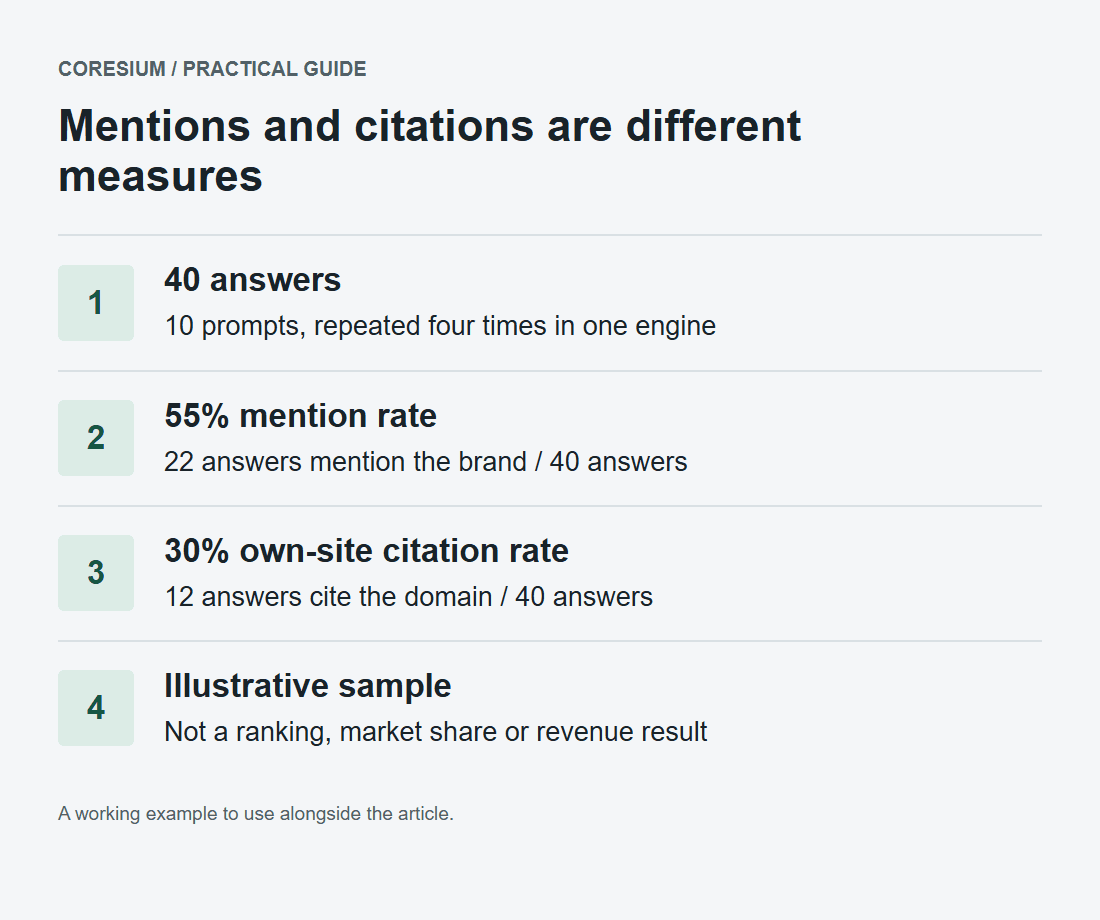
Suppose you test ten buyer prompts four times each in one engine during a week. That creates 40 successful answer observations. If 22 answers mention your brand and 12 link to your own domain, the mention rate is 22 / 40 = 55%, and the own-domain citation rate is 12 / 40 = 30%. These are illustrative figures, not Coresium results or market benchmarks.
Prompt group | Answer observation | What to save |
|---|---|---|
Category: how does B2B lead routing work? | Brand mentioned, no own-site link | Engine, timestamp, answer excerpt and prompt version |
Implementation: how do we connect CRM qualification to Ads? | Own-site guide cited | Exact cited URL and whether the brand is also named |
Comparison: in-house team or external marketing support? | Other providers named, brand absent | Named providers, sources and the full comparison context |
Count each answer at most once for a mention-rate numerator, even if it repeats the name. Define own-domain citations separately from any mention of your brand on a third-party page. Record unsuccessful requests separately: if five additional attempts failed, report 40 successful answers and five failures, not 45 equivalent observations.
Compare like with like across reporting periods. If the prompt mix, engine settings or country changes, label that change. A rise in this sample's citation rate is evidence of increased observed presence, not proof of a larger market share or extra revenue.
Connect observed visibility to pipeline without overstating attribution
Tag known AI referrals in analytics where referrers are available, then compare their landing pages, engaged sessions, conversions and CRM progression with other acquisition sources. Evaluate your own data over a consistent period: referral volume and session quality answer different questions.
Use a documented attribution framework to reconcile campaign costs, website behaviour, lifecycle stages, deals and closed revenue. Record direct AI referrals separately from self-reported discovery and other assisted touchpoints. An attribution model cannot recover every unobserved AI interaction or prove that an answer caused a sale.
Build an Executive Dashboard for Tracking AI Search Performance
An executive dashboard should show a concise trend, the evidence behind it, and the business implication. Coresium approaches SEO and AEO as connected demand-generation work, so the most useful report links content visibility to qualified attention and pipeline signals instead of presenting a standalone AI score.
Use a governed reporting structure
Create a measurement dictionary for every metric that names the source, definition, coverage, known limitation, and reporting period. Keep prompt-panel results clearly labeled as observed samples, because they are not total market share, and keep platform-generated impressions separate from referral sessions to prevent overlapping counts.
Report changes alongside an explanation: new citations may follow a content update, a crawler-access correction, a strengthened source page, or a broader shift in how an engine retrieves. When an assistant gives an inaccurate answer, identify the cited source, correct the authoritative page and supporting profiles, then monitor the same prompt rather than assuming publication alone will fix the result.
Prioritize pages and prompts closest to revenue
Start with evaluation and solution prompts connected to your highest-value offers, then expand to informational questions that feed those journeys. A recurring technical SEO audit matters here because inaccessible, duplicated, or poorly structured pages can limit ordinary search visibility and supporting-link eligibility at the same time.
Tool selection should be driven by auditability, not dashboard design. Keep answer excerpts, citations and sampling settings accessible. For Google AI features, Google explains their reporting in Search Console: their traffic is included in the overall Web search type. Do not present that combined report as an isolated AI visibility score.
Conclusion
Credible AI search measurement starts with a fixed set of buyer prompts and ends with evidence that connects visibility to commercial behavior. Track mentions, citations, answer accuracy, known referrals, and qualified outcomes as separate measures, then interpret them by engine and intent. Coresium works with growth teams that need SEO and AEO connected to content execution, measurement, and pipeline priorities. The goal is not to manufacture a perfect visibility score, but to make the next content, technical, and demand-generation decision easier to defend.
Ready to turn AI-search observations into an operating plan? Discuss strategy and implementation support with Coresium for practical next steps.
Frequently Asked Questions (FAQs)
What are the best metrics for AI search optimization?
The best metrics for AI search optimization are prompt-level mention rate, citation rate, answer accuracy, cited-page recurrence, known AI referral quality, and qualified conversion progression, because each measures a different part of visibility rather than forcing a complex and variable answer environment into one misleading score.
Why does AI search matter for B2B lead generation?
AI search matters for B2B lead generation because buyers can receive a shortlist, category explanation, and source recommendations before they visit a vendor website, making accurate brand inclusion and credible supporting content important earlier in the evaluation journey.
How does AEO differ from traditional SEO?
AEO differs from traditional SEO because it focuses on whether content can be extracted, cited, and used to answer a question within an AI-generated response, while traditional SEO primarily measures indexed visibility, rankings, impressions, clicks, and organic landing-page performance.
Is AI search visibility trackable with current tools?
AI search visibility is trackable with current tools when teams combine scheduled prompt monitoring, recorded answer excerpts, citation URLs, analytics referral data, search-platform reporting, and CRM outcomes, while clearly acknowledging that some AI-influenced activity cannot be identified at the session level.
How to measure the ROI of AI search visibility?
Measure the ROI of AI search visibility by comparing investment in content, technical improvements, and monitoring against known AI-referred conversions, assisted opportunities, pipeline progression, and revenue outcomes, while treating unobservable influence as contextual evidence rather than directly attributed revenue.
You might also like