Back
Insights

Quick Answer
Google Ads for B2B services produces poor leads when campaigns optimize for cheap form submissions instead of sales-accepted opportunities, while targeting, landing pages, and follow-up fail to filter for fit. The fix is a connected operating system: target high-intent searches, make qualification visible before the form is submitted, and return CRM outcomes to the ad account.
Introduction
Improving B2B lead quality starts by treating Google Ads as a demand-capture channel, not a volume machine. A campaign can generate a steady stream of inquiries and still damage pipeline performance if those contacts lack authority, urgency, budget, or a problem the service actually solves. For B2B services, the gap usually appears between the ad click and the sales conversation, where vague search intent, generic offers, weak qualification, and inconsistent handoffs compound. Sales teams then reject leads, marketing sees acceptable cost per lead, and neither side has the data needed to diagnose the problem.
Key Takeaways:
Optimize toward sales-accepted outcomes rather than raw lead volume.
Use keywords, forms, and landing pages to screen for buyer fit.
Connect CRM stages to bidding decisions before scaling spend.
Why Google Ads for B2B Services Attracts the Wrong Leads
Lead quality problems are usually structural rather than caused by a single setting. B2B Google Ads campaigns become expensive when they are built around traffic or form-fill targets before the business has defined which companies, roles, use cases, and buying signals deserve sales attention. The platform will pursue the conversion action it receives, even when that action has little relationship to revenue.
Find the Break Before Changing Bids
Start with the lead journey, not the dashboard. Compare search terms, ad messaging, landing-page submissions, CRM records, sales disposition, and opportunity creation to locate the first point where fit declines. A useful conversion tracking strategy preserves the click source and campaign context through that journey, so sales feedback can correct marketing decisions rather than remain anecdotal. Google offers qualified and converted lead goals so the conversion signal can reflect a later business stage rather than only a form submission.
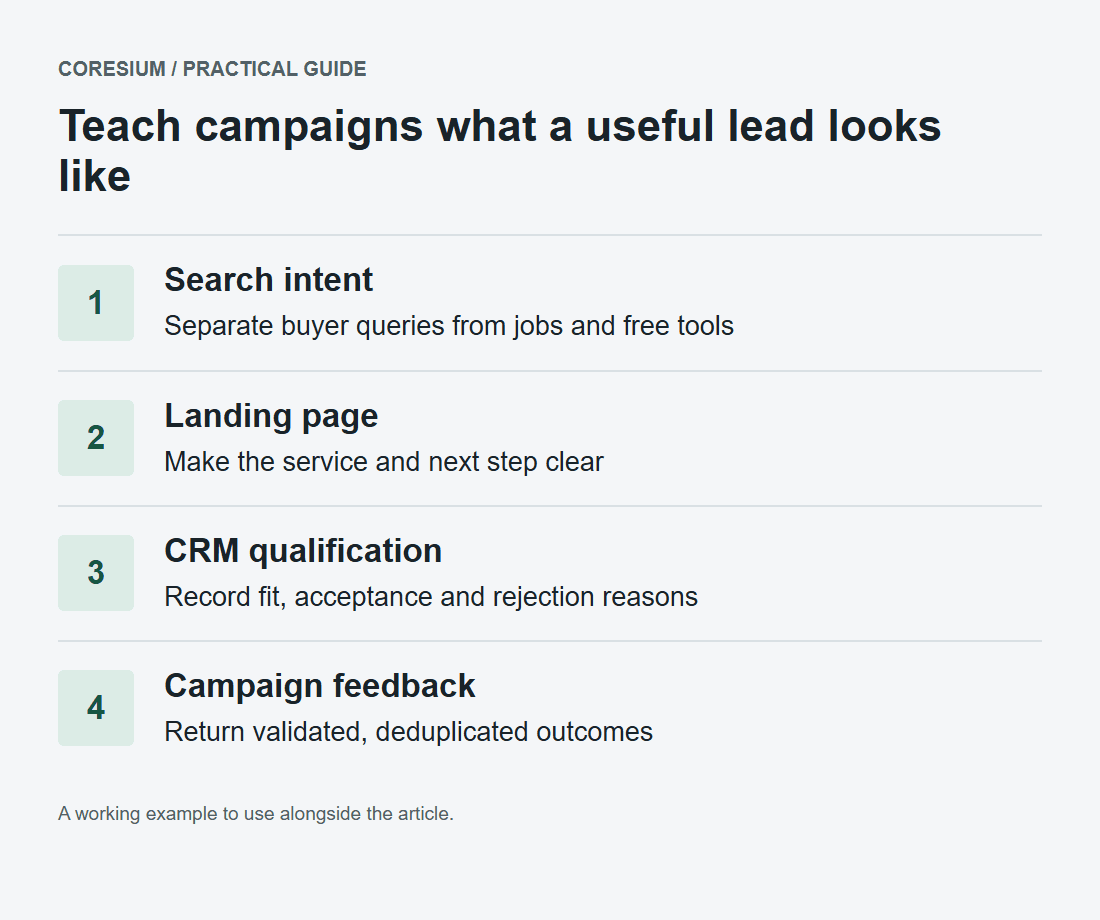
Search intent: Separate solution searches from research, jobs, templates, and education.
Firmographic fit: Define target industries, company profiles, and excluded segments.
Role relevance: Identify decision-makers, influencers, and non-buying users.
Offer alignment: Match each ad promise to a specific service outcome.
Sales outcome: Record why accepted leads advance or are rejected.
Control Intent Before the Click Becomes a Lead
Keyword selection is the first quality filter. Broad, ambiguous terms often attract people seeking employment, training, free tools, definitions, consumer services, or providers outside your market. Review the search terms report alongside lead dispositions, then build negative keyword lists from real mismatch patterns rather than assumptions. This is the practical core of troubleshooting low quality B2B leads: identify the queries associated with poor-fit records, exclude them, and preserve only terms that consistently signal a commercial problem your team can solve.
Campaign structure should also separate distinct buying motives. A prospect searching for a provider, consultant, implementation partner, or managed service is evaluating differently from someone seeking a definition or downloadable template. Distinct ad groups, ads, and conversion paths make it possible to see which intent tier creates accepted conversations. Do not combine every related phrase into one campaign merely to simplify account management, because the blended data conceals where spend is being wasted.
How to Improve B2B Lead Quality Across the Funnel
Better lead quality comes from matching every stage of acquisition to the same ideal customer profile. A focused paid media strategy connects buyer research, search intent, offer design, qualification rules, sales capacity, and reporting. Without that connection, optimizing Google Ads for B2B leads becomes a cycle of bid changes that cannot solve a message, market, or handoff problem.
Use Landing Pages and Forms as Qualification Tools
Your landing page should continue the exact promise made in the ad and make the service scope clear enough to discourage the wrong visitor. Generic pages that present every capability invite broad inquiries, while a page built around a defined problem, buyer role, engagement type, and expected outcome creates productive friction. Strong landing page optimization is not about forcing more conversions. It is about helping suitable prospects recognize themselves while making poor-fit visitors less likely to submit.
Ask only questions that sales will actually use: business email, company, role, service need, current challenge, and timeline can distinguish a potential buyer from a casual researcher. Avoid forms that collect information simply because it might be useful later. Each field should either qualify the lead, route it correctly, or support an informed first response.
Clear qualification can improve acquisition economics, but each business should validate performance against its own sales cycle and margins. The operational lesson is sound: sales capacity spent on unsuitable contacts is part of campaign cost, even when the media dashboard reports an efficient cost per lead.
Use the comparison below to decide which signals belong in the ad account and which belong in the sales process.
Signal | Where to capture it | What it indicates | Operational response |
|---|---|---|---|
Search query | Google Ads | Stated problem and urgency | Refine keywords and negatives |
Company and role | Lead form | Account and authority fit | Route or disqualify |
Service need | Landing page form | Offer relevance | Customize first response |
Sales acceptance | CRM | Commercial viability | Import qualified conversions |
Opportunity status | CRM | Pipeline contribution | Guide budget decisions |
The key distinction is ownership. Google Ads can capture intent and optimize from imported signals, but sales must define what acceptance and opportunity creation mean in the context of the service and its buying process.
Train Campaigns on Sales Outcomes, Not Form Fills
Google Ads conversion tracking for B2B should record the initial inquiry, but it should not stop there. Send lead status changes back from the CRM, including accepted lead, qualified meeting, opportunity, and closed business where your process supports it. This gives the platform a more meaningful optimization signal and gives leadership a shared view of whether paid search contributes to revenue rather than merely producing contacts.
Do not rush to automated bidding based on weak conversion data. Start with tightly controlled Search activity while validating tracking, search terms, ad-to-page alignment, and sales outcomes. A reliable read on qualified pipeline can take 2 to 3 months, plus the sales cycle needed to observe revenue, so frequent tactical changes can erase the very evidence required for a sound decision.
Lead scoring should combine company and role fit with relevant behaviour, such as a direct consultation request. Agree the acceptance rule with sales, record rejection reasons and keep scoring distinct from the conversion action imported into Ads. A high score is not a substitute for a consistently recorded commercial outcome.
Example: make the feedback specific enough to act on
Consider a CRM implementation firm that sells paid projects to businesses. A search for "CRM implementation jobs" is not the same intent as "CRM implementation partner for sales team". If the first query repeatedly brings job applicants, review the search terms and add a relevant negative keyword such as "jobs", using the match behaviour explained in Google's negative-keyword guide. Do not exclude a whole service term because one lead was unsuitable.
Lead outcome | CRM record | Campaign response |
|---|---|---|
Job applicant | Rejected: employment enquiry | Review recruitment queries and negatives |
Student asking for a free project | Rejected: no business engagement | Check query, ad promise and offer clarity |
Business buyer needing a supported integration | Qualified: company fit, service need and sales acceptance confirmed | Record a qualified-lead conversion with the correct identity and timestamp |
Contact already recorded as qualified | Same lead, same qualifying event | Deduplicate; do not import it as a new qualification |
The qualification rule must be shared by sales and marketing. For this example, a form submission alone is not a qualified lead; company fit, a supported project and an accepted sales conversation are required. Google distinguishes qualified and converted lead goals. Select the actual stage your team can consistently record, validate the import and only then use it to guide optimisation.
Fix the Handoff That Turns Good Interest Into Lost Pipeline
Many B2B PPC lead quality issues are actually follow-up failures. A relevant prospect can look unqualified when contact details are incomplete, ownership is unclear, the first response is generic, or sales receives no context about the search term and offer that initiated the inquiry. Create a visible handoff rule: qualifying information enters the CRM, the right owner receives the record, and rejected leads receive a reason code that marketing can review.
Build marketing automation workflows for leads that match the target account but are not ready to speak with sales. Educational follow-up, service-specific proof, and relevant case studies can keep those contacts engaged without filling calendars with premature meetings. B2B lead generation depends on identifying ideal buyers and guiding them through a sales process, not treating every early-stage interaction as an immediate sales request.
Google Ads vs LinkedIn Ads for B2B is not a question of which platform is universally better. Google captures people searching for a solution now, while LinkedIn can reach defined roles and accounts before a search begins. Use Google when clear search demand exists, use LinkedIn to support account-focused reach and nurturing, and judge both channels on accepted opportunities and pipeline movement rather than platform-reported lead totals. For global teams, an international B2B PPC strategy also requires localized search terms, service eligibility, language clarity, and routing rules that prevent inquiries from unsupported markets.
Coresium approaches paid acquisition as part of a connected demand-generation system, linking targeting, campaign execution, SEO and AEO visibility, automation, and senior marketing direction to the pipeline measures that leadership needs.
Conclusion
Reducing junk leads from Google Ads starts with a clear definition of a qualified buyer and a campaign structure designed to find that buyer. Tighten intent, align ads to dedicated landing pages, add useful qualification fields, and return sales outcomes to the platform before increasing budget. Measure accepted leads, opportunities, and pipeline alongside cost, then use sales rejection reasons as evidence for the next optimization cycle. For growth leaders who need connected execution rather than isolated channel management, Coresium supports aligning paid media with qualified pipeline.
Ready to diagnose the full acquisition path? Discuss strategy and implementation support with Coresium for a practical review of your paid pipeline.
Frequently Asked Questions (FAQs)
Why are Google Ads B2B leads low quality?
Google Ads B2B leads are low quality when broad search intent, generic offers, weak forms, or form-fill optimization attract people who do not match your ideal customer profile, and the fastest diagnosis is to compare search terms and sales rejection reasons for the same lead cohort.
How to improve B2B lead quality in Google Ads?
Improving B2B lead quality in Google Ads requires narrowing keyword intent, excluding irrelevant queries, aligning ads with service-specific landing pages, collecting useful qualification details, and importing CRM stages so campaign optimization reflects accepted opportunities rather than every submitted form.
What causes poor lead quality in B2B PPC campaigns?
Poor lead quality in B2B PPC campaigns is commonly caused by unclear ideal customer definitions, broad matching between keywords and offers, weak message alignment, inadequate form qualification, and delayed feedback from sales, which leaves marketing optimizing activity without knowing which activity creates pipeline.
How do I qualify B2B leads from Google Ads?
Qualify B2B leads from Google Ads by evaluating company fit, job role, stated need, timing, and engagement behavior in a shared CRM process, then recording whether sales accepted the contact and why so the campaign can learn from commercial outcomes.
How to connect Google Ads to B2B pipeline?
Connect Google Ads to B2B pipeline by preserving campaign and click context in the CRM, standardizing lifecycle stages with sales, and feeding accepted leads and opportunities into reporting and bidding decisions, which exposes the difference between inexpensive inquiries and revenue-relevant demand.
You might also like