Back
SEO and Content

Quick Answer
Meta description: A practical guide to content marketing automation for agencies: what to check, common mistakes to avoid, and how to make a better owner-side decision.
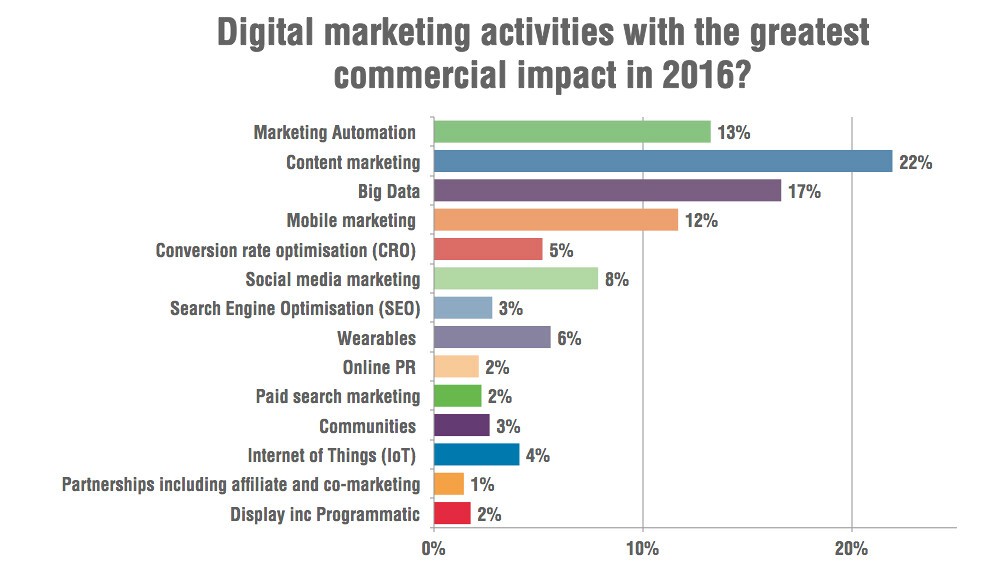
_Image: Marketing Trends for 2016 by josephw.craven, BY-SA 2.0_
Content marketing automation for agencies uses AI and workflow tools to generate, distribute, and optimize written content at scale--reducing manual creation time while maintaining quality and relevance for client campaigns.
In B2B marketing, this automation typically handles repetitive tasks: drafting blog posts from research briefs, personalizing email sequences, scheduling social posts across channels, and analyzing performance data to inform the next round of content. The goal is to free your team from low-value work so they can focus on strategy, client relationships, and creative direction.
When it's useful: Automation works best when you have clear content templates, consistent brand voice across clients, and enough volume to justify setup time. It struggles when clients demand highly customized narratives or when your process is still ad-hoc.
Before you act, check:
Whether your team's bottleneck is actually content creation or something else (like approval cycles or strategy)
If your clients' brands are distinct enough that templated automation would feel generic
Whether the tool integrates with your existing CRM, project management, and analytics stack
Coresium helps agencies evaluate whether automation fits your workflow and, if it does, implement it without losing the human judgment that keeps client work effective.
For neutral background on this topic, review SEO Starter Guide: The Basics | Google Search Central | Documentation | Google for Developers.
Key Takeaways
Use content marketing automation for agencies to answer one search intent clearly instead of covering every growth topic at once.
Connect the article to a real Coresium service or operating page where the reader can act.
Use external links for neutral references and internal links for Coresium's point of view.
Break the article into scannable sections for search readers and AI answer engines.
Coresium can help teams turn this strategy into a practical operating workflow.
When Readers Should Care About This
What this means
You should evaluate content marketing automation if your agency is losing margin to manual content work, struggling to scale client delivery without hiring, or watching your best strategists spend afternoons formatting and scheduling instead of building campaigns.
The real decision point is operational. Most agencies hit a wall around 8-12 active client accounts. At that scale, your team can no longer hand-write every social post, email sequence, or blog outline without either burning out or missing deadlines. You're either hiring more junior staff (which compresses margins), turning down new clients (which caps revenue), or accepting lower-quality output (which damages retention).
Content automation addresses this by removing the mechanical parts of the job--the drafting from briefs, the formatting for different channels, the scheduling across platforms, the first-pass editing. What it doesn't do is replace strategy, client relationships, or creative judgment. Those stay with your team.
How to use it
The financial case is straightforward. If a strategist costs $80-120K annually and spends a percentage of their time on tasks that automation can handle, you're looking at $40-60K in recoverable capacity per person. Multiply that across a team of five, and the math becomes hard to ignore. That's not hypothetical savings--it's billable time you can redirect to higher-margin work or client growth initiatives.
You should also care if your clients expect faster turnaround. In 2026, B2B buyers expect content on a tighter cadence than agencies could deliver five years ago. Automation lets you meet that expectation without proportionally increasing headcount.
The catch: automation only works if you have clear content standards, repeatable processes, and realistic expectations about what the tool can do. If your workflows are chaotic or your briefs are vague, automation will just make bad work faster.
Step-By-Step Checklist
Items to confirm first
Start with your current workflow. Map out how your team handles content from brief to publish--where do bottlenecks happen? Which tasks repeat across clients? Which ones don't require strategic judgment? This clarity matters because automation works best on repetitive, rule-based work, not on strategy.
Audit your content types and volume.
How many pieces per client per month?
How many clients run similar content calendars?
Which formats appear most often (blog posts, case studies, email sequences, social)?
Where does manual formatting, resizing, or scheduling consume the most time?
Identify your automation priorities. Focus on the tasks that consume the most labor without adding strategic value. For most agencies, this means:
Scheduling and distribution across channels
Image resizing and optimization for multiple platforms
First-draft generation from approved briefs or outlines
Content calendar management and deadline tracking
Basic metadata and SEO field population
Records to keep
Set success metrics before you implement. Decide what "better" looks like. Common measures include:
Hours saved per client per month
Turnaround time from brief to publish
Number of content pieces your team can handle without new hires
Margin improvement per client account
Choose based on your tech stack, not hype. Does the automation tool integrate with your CMS, email platform, and project management software? Can your team actually use it without constant support tickets? Will it work with your existing client workflows, or does it force you to rebuild everything?
Start with one client or content type. Don't automate your entire operation at once. Pick your highest-volume, most repetitive client work and run it through the system for a variable timeline. Measure the actual time saved. Use that data to decide whether to expand.
Plan for the learning curve. Your team will need training. Automation tools require setup time, template building, and workflow adjustments. Budget a variable timeline before you see real efficiency gains.
Common Mistakes To Avoid
Why this usually goes wrong
Most agencies adopt content marketing automation with good intentions and poor execution. The mistakes that follow are predictable--and avoidable if you know what to watch for.
Automating before you have a process. This is the biggest one. Agencies often buy automation tools hoping the software will create structure. It won't. If your content workflow is unclear, inconsistent, or manual in ways you haven't documented, automation will just speed up the mess. Before you implement any system, you need to know exactly what you're automating. That means mapping your current workflow, identifying which steps are truly repetitive, and agreeing on standards across your team. Skip this, and you'll automate chaos.
How to reduce the risk
Setting it and forgetting it. Automation isn't a one-time setup. Templates drift. Client briefs change. Your team learns better ways to do things. If you deploy an automated workflow and don't review it quarterly, you'll end up publishing content that doesn't match your current standards or client needs. Build in checkpoints--monthly or quarterly--to audit what the system is producing and adjust rules or templates as needed.
Measuring the wrong things. Many agencies track automation success by counting pieces published or time saved. Those matter, but they're not the full picture. What you should measure: Are clients happier with turnaround time? Is your team spending the freed-up time on strategy and client relationships, or just taking on more clients? Is content quality holding steady or slipping? Are conversion rates or engagement metrics moving? If automation saves you a variable timeline a week but your content quality drops a percentage, you've made a bad trade.
Choosing a tool before defining your needs. Agencies often reverse-engineer their workflow to fit a popular tool instead of choosing a tool that fits their workflow. Before you evaluate software, know what you need to automate, what your team needs to control manually, and what integrations matter (CMS, analytics, client portals, design tools). This clarity prevents expensive tool-switching later.
How Coresium Helps You Decide
Where the brand fits
Content marketing automation for agencies isn't a binary choice between manual work and full automation. It's a staged decision: what to automate first, how to measure the impact, and whether your team has the bandwidth to manage the tools you're buying.
The mistakes in the previous section--automating before you have a process, choosing tools before defining your workflow, measuring the wrong metrics--are common because agencies evaluate automation in isolation. They look at feature lists instead of fit.
A better approach is to audit your current state first. Map your actual content workflow: who creates briefs, who writes, who reviews, who publishes, who distributes, who measures. Document the bottlenecks. You'll likely find that automation solves only some of them. The rest require process change, clearer ownership, or better handoff discipline.
When to use this support
Once you know what's actually broken, you can evaluate tools against your specific constraints: team size, content volume, client diversity, and the quality bar your clients expect. A tool that works for a 20-person agency producing 50 pieces a month may create friction for a 5-person shop doing 200 pieces a month with highly customized client requirements.
Success also depends on how you measure it. Most agencies track output (pieces published, distribution reach) but miss the leading indicators that matter: time saved per piece, reduction in revision cycles, consistency in brand voice across clients, or faster time-to-publish. If you don't know which metric moves your business forward, you won't know if the tool is worth the cost or the learning curve.
Coresium helps agencies think through this decision systematically. Rather than selling you a tool, we help you clarify your workflow, identify where automation creates real leverage, and build a sustainable content operation that scales without sacrificing quality. If you're evaluating automation options or trying to fix a broken implementation, start here to talk through your specific situation.
You might also like