Back
Insights

Quick Answer
A lifecycle email strategy for a B2B service business should use CRM data, buyer-stage triggers, and clear sales handoffs to keep qualified prospects moving. Start with a small set of high-value sequences, then improve them using conversion and pipeline outcomes rather than email opens alone.
Introduction
Lifecycle email marketing helps B2B service firms replace inconsistent follow-up with relevant communication tied to what a buyer has done, requested, or needs next. The goal is not to send more email. It is to deliver timely proof, guidance, and next steps that help multiple stakeholders progress through a complex purchase. A strong program also supports customers after the sale, when onboarding quality and visible value shape retention. Generic newsletter calendars fail because they ignore the account context behind each interaction.
Key Takeaways:
Map emails to buyer intent, not a fixed promotional calendar.
Use CRM signals to trigger sales-ready follow-up and customer education.
Measure qualified conversations, opportunities, retention, and expansion alongside email engagement.
Build a B2B Email Marketing Strategy Around Buyer Stages
Begin with the buyer journey already happening across your site, content, sales calls, and CRM. Document the moments when a prospect needs a useful answer, a decision-maker needs reassurance, or a customer needs help reaching an early outcome. Connecting those moments to lead generation workflows prevents leads from disappearing after a form fill or first conversation.
Create B2B Customer Journey Email Mapping
B2B customer journey email mapping should distinguish awareness, evaluation, active opportunity, onboarding, adoption, retention, and expansion. At each stage, define the audience, trigger, message, owner, call to action, and exit condition. This turns B2B lead nurturing campaigns into an operational system rather than a collection of emails written in isolation.
Awareness: Send problem education after a content subscription.
Evaluation: Deliver use cases after high-intent page visits.
Opportunity: Reinforce next steps after a sales conversation.
Onboarding: Clarify responsibilities after contract signature.
Segment by Account Context and Behavior
Segmented email marketing for B2B should combine firmographic fit, role, lifecycle stage, source, content engagement, sales status, and customer status. A founder researching a strategic issue needs a different message from an operations leader comparing implementation approaches. Use B2B lead automation to apply these rules consistently, while allowing sales representatives to pause or adjust messages for active conversations.
Turn Lifecycle Signals Into Sales and Customer Workflows
A B2B marketing automation strategy works when the trigger reflects intent and the next action has an owner. A webinar registration, pricing-page visit, proposal review, onboarding milestone, or drop in engagement can all create a relevant task or sequence. The practical test is whether the workflow improves sales pipeline automation without making the buyer experience feel automated.
Design a Full-Funnel B2B Email Strategy
For new leads, use a short educational series that addresses the business problem, common approaches, and the decision criteria buyers need before speaking with sales. For active opportunities, send materials that reduce internal friction, such as stakeholder-specific summaries, implementation expectations, and answers to recurring objections. A nurture sequence for B2B decision makers should stop when a prospect replies, books a meeting, or reaches a defined sales stage.
Use one primary action per email, such as reading a guide, replying with a priority, reviewing a proposal, or scheduling a discussion. Email opens are directionally useful, but privacy features can distort them; clicks, replies, meeting creation, opportunity progression, and revenue influence provide a stronger view of performance. A documented conversion tracking strategy should connect each lifecycle stage to the next meaningful business outcome.
A three-email sequence you can actually map
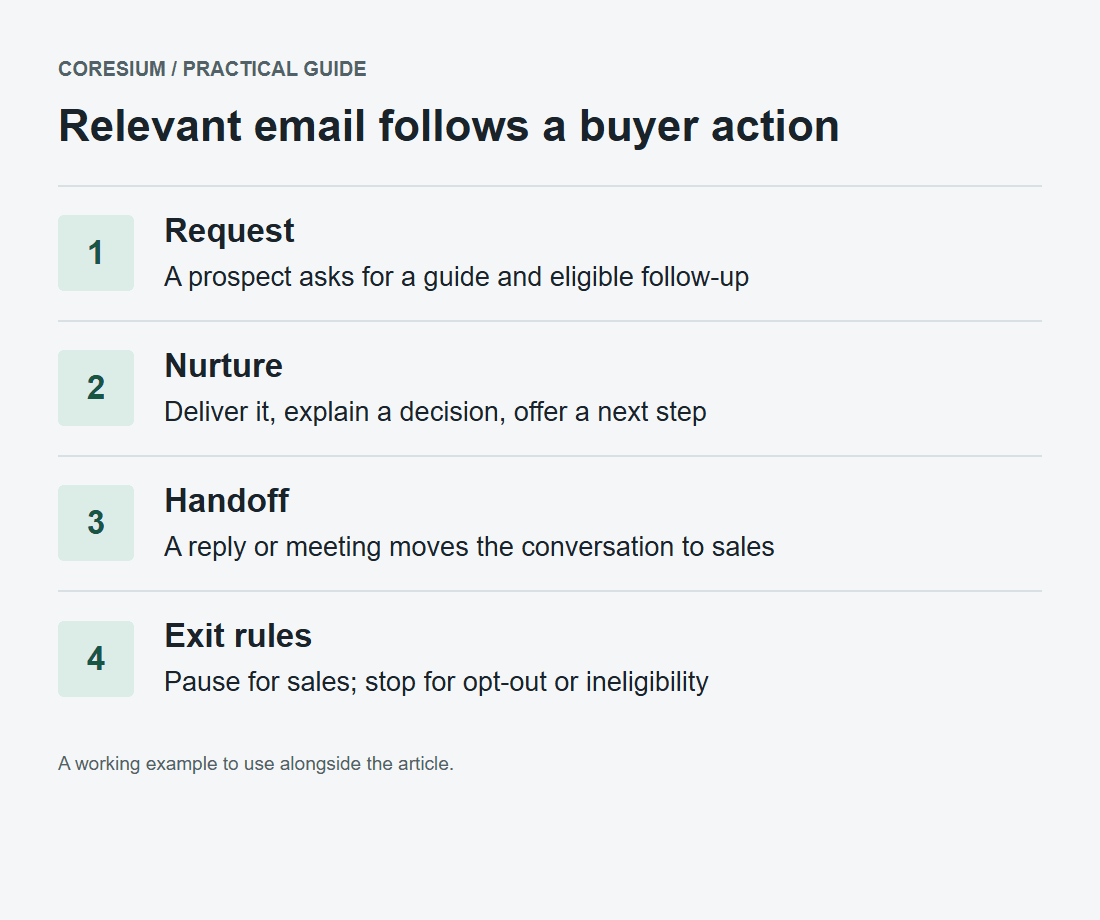
This illustrative sequence is for a prospect who requested a CRM rollout guide and agreed to relevant follow-up. It is not a cold-outreach sequence or a promise of improved conversion rates. Keep the timetable flexible and respect the subscriber's permissions.
Trigger and timing | Email content | One next action |
|---|---|---|
Guide requested: immediately | Deliver the guide, explain who it is for and ask which rollout problem matters most | Read the guide or reply with the priority |
Still eligible: around day 3 | Explain one implementation decision, such as ownership of lead routing, with a short checklist | Use the checklist |
Still eligible: around day 7 | Share a relevant, approved example and offer a focused discussion of the stated problem | Book a conversation |
Check eligibility before every send, not just at enrolment. Exit or pause the sequence when the prospect replies, books a meeting, unsubscribes, becomes a customer, bounces or enters an active sales conversation. Do not restart a completed sequence because the same contact downloads the same guide again.
Assign one CRM field for lifecycle stage, an owner for sales follow-up and a suppression rule for active opportunities. Keep delivery of a requested resource separate from ongoing promotional follow-up. Measure qualified replies and meetings for this sequence; measure onboarding completion for a customer sequence. Those are different jobs and should not share a single success target.
Protect Deliverability, Consent, and Trust
Build compliance checks into every workflow before it scales. The FTC states that commercial messages must provide a functioning opt-out process, and requests must be honored within 10 business days under CAN-SPAM compliance requirements. For global audiences, consent records, clear purpose statements, privacy notices, and easy unsubscribes should be reviewed against the applicable rules described in global email marketing laws.
Measure Lifecycle Performance and Improve the System
Measure each sequence against its job, not against a universal open-rate target. Welcome emails should create meaningful engagement, opportunity sequences should support meetings and stage movement, and onboarding emails should drive completion of required customer actions. This is where data-driven marketing becomes useful: it connects message performance to the commercial result the sequence was designed to influence.
Use a Monthly Review Cadence
Review segment membership, trigger accuracy, deliverability, replies, conversions, pipeline contribution and sales feedback each month. Compare by source, persona and stage before changing copy. Keep a change log showing the trigger, audience, copy revision and outcome so the team can distinguish a targeting problem from a writing problem.
Coresium can help growth teams align lifecycle messaging, CRM rules, paid acquisition, and sales follow-up when ownership is fragmented. The work should begin with the current customer journey and revenue process, then translate proven touchpoints into an executable operating model.
Know When to Add Strategic Ownership
Bring in senior marketing support when lifecycle stages are unclear, CRM data is unreliable, sales and marketing use different qualification criteria, or campaigns cannot be tied to pipeline. A fractional leader can establish governance, clarify the measurement model, and coordinate execution across channels without treating email as a standalone tactic.
Conclusion
A practical lifecycle program gives every qualified prospect and customer a relevant next step while preserving room for human sales judgment. Map the journey first, segment around real account signals, automate only repeatable decisions, and measure progress through pipeline and customer outcomes. Coresium works with B2B service teams that need lifecycle strategy connected to hands-on marketing execution, lead generation, and CRM-based follow-up. Start with the sequences where missed follow-up currently costs the most momentum.
Ready to connect email activity to qualified pipeline? Discuss strategy and implementation support with Coresium.
Frequently Asked Questions (FAQs)
How to build a B2B lifecycle email strategy?
To build a B2B lifecycle email strategy, map your buyer and customer stages, define triggers and owners for each stage, connect the workflows to CRM fields, and launch the highest-impact sequences first so the team can validate handoffs before expanding automation.
What are the best lifecycle email stages for B2B?
The best lifecycle email stages for B2B are awareness, evaluation, active opportunity, onboarding, adoption, retention, and expansion, although the exact labels should match how sales and customer teams currently define progress within the business.
How do I automate lead nurturing for B2B startups?
To automate lead nurturing for B2B startups, use behavioral and CRM triggers to send educational content, route high-intent activity to sales, suppress contacts in active conversations, and review whether nurture engagement converts into qualified meetings rather than merely generating clicks.
What metrics should I track for B2B email campaigns?
The metrics to track for B2B email campaigns are delivery, unsubscribe, click, reply, meeting, opportunity creation, stage progression, customer activation, retention, and expansion, because these measures show whether email activity contributes to commercial outcomes.
How to segment B2B leads for email marketing?
To segment B2B leads for email marketing, group contacts by account fit, job role, source, stated interest, website behavior, content engagement, lifecycle stage, and sales status, then ensure each group receives messages that match its current decision context.
You might also like